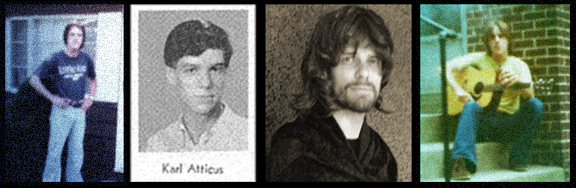
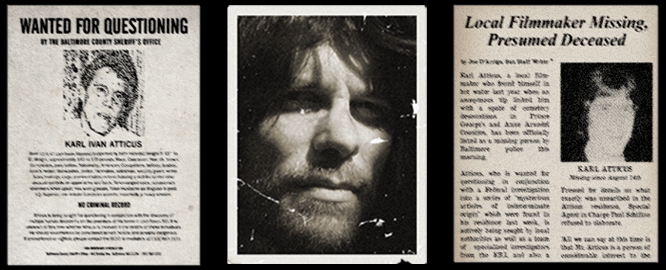
Do You Remember Karl Atticus? Karl Atticus Wanted poster and newspaper clippings about Karl Atticus

KARL ATTICUS was a filmmaker from the Baltimore, Maryland area. He was last seen alive during the summer of 1973; remains subsequently identified as his were located in Howard County, Maryland several months later. His death was ultimately ruled a suicide, but many questions remain about the circumstances of his demise, as well as the life that preceded it.

We have been investigating this man and his work for a number of years, and if any one thing has become obvious, it is that nothing can be taken for granted pertaining to Karl Atticus or his work. The name itself seems to elicit a negative (in some cases violent) response from people who were known to have associated with him. In most instances, however, there is scant information to be found. We have encountered situations in which any reference to his very existence has been denied, deleted, removed or expunged from public records.

For a man who made two movies, there still seems to be a great lot of unanswered questions...questions to which certain parties do not want the answers divulged, for some reason.

Our initial foray into the legend resulted in a fair amount of information, much more than we had expected to find, but clearly just the tip of the proverbial iceberg. Some of this information leaked and ended up online over the years - presumably due to our sudden interest in a case that had lain dormant for four decades.

Recently, however, events have taken a sinister turn. Pages of information on Karl Atticus began to be shut down or deleted altogether. People who were initially open and forthright no longer returned our phone calls or e-mails. Avenues of research to which we previously enjoyed access began to be closed off to us.

There is obviously something larger at stake, something that a particular person or group appears to be actively protecting. One anonymous caller has suggested that elements of the film industry are working to prevent any inquiries into Atticus's past; others have suggested that religious activists may be trying to deliberately suppress the very memory of this man.

The upshot of which is: Why? Who would go so far out of their way, this many years after the fact, to discredit an investigation into events which transpired 40 years ago?

We will attempt to recap as much of the basic information on our website as we have been able to uncover, in spite of these cowardly, anonymous attempts to compromise our research.

If you have any information on Karl Atticus or his films, please contact us at:

info@crypticpictures.com
Karl Atticus - Personal History
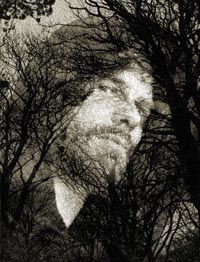
Photos of Karl Atticus

Karl Ivan Atticus (October 4th, 1947 - August 1973) was an American filmmaker. A native of Baltimore, Maryland, Atticus's brief career earned him a place in the pantheon of cult movie directors, having achieved a modest level of notoriety for two extremely violent films, Culture Shock and Mortal Remains. He is regarded by many in the film industry as the forgotten "father of the modern slasher movie." As he was also implicated in a string of incidents involving cemetery vandalism or desecration (some have suggested that he was in fact a necrophile), he has over the years become a figure of urban legend in Maryland, though he was never formally charged with these crimes.

Atticus was born in late 1947 in Loch Raven, a suburban neighborhood within the Baltimore city limits. His father, Professor Ivan Atticus, a tenured instructor of English literature at Johns Hopkins University, perished in 1950 in an automobile accident. A sickly child who was quarantined for over a year due to polio, Atticus continued to live with his mother, Margaret (née Cowan), for many years until she died in June 1970. Atticus never left his childhood home in Loch Raven, though the family also owned a summer house in Jessup, a rural community in neighboring Howard County. He had no siblings.

Atticus, an avowed fan of fantasy and horror tales, was fixated from an early age on the works of authors such as Arthur Conan Doyle, Edgar Allan Poe, Vernon Blake, Robert E. Howard, and H. P. Lovecraft, among others. A childhood acquaintance of Atticus's once indicated that, as a boy, Karl spent "more time in the library than at home." By adolescence, this segued into a burgeoning fascination with cinema. In one published interview, Atticus cited among his influences the works of Henri-Georges Clouzot and Luis Buñuel. He was also profoundly affected by the works of Antonin Artaud, taking particular interest in the manifesto behind his "Theatre of Cruelty"; unlike Artaud, however, Atticus chose to interpret the term "cruelty" much more literally.

Atticus's primary claim to fame is as the director of a film which sparked a violent reaction from its audience. The midnight premiere of Mortal Remains at the Patterson Theater in Baltimore was cut short when some members of the audience, presumably enraged by the film's content (or possibly its quality, as some have half-jokingly suggested) literally rioted and caused significant damage to the building. The sole print of the film was also partially destroyed, and the film has thus become something of an apocryphal legend as a result. Contemporary news reports placed responsibility for the incident on "Hells Angels" or "hippies," while others simply attributed the outburst to recreational drug use.

Largely forgotten today, this incident has nevertheless been immortalized in published fiction, television, and cinema as the inspiration for stories involving "the film which drove its audience mad."

Atticus committed suicide in mid-1973; his remains were discovered in a wooded area adjacent to his family's cabin in Jessup. Some people speculate that depression ran in the family, as his mother Margaret had taken her own life only three years prior. A hiker stumbled across the badly decomposed body of the young filmmaker and contacted the authorities, who determined the cause of death as self-inflicted gunshot (a 12-gauge shotgun was found within reach of the decedent). As the body was headless, and extensive decomposition prevented fingerprint analysis, the major determining factor which led investigators to conclude that the remains were those of Karl Atticus was a large, elaborate tattoo visible on its torso.

Vernon Blake (1888-1937)

Vernon Theodorus Blake (1888 - 1937) was an American author and occultist based in New Orleans, Louisiana. He began his career as a war correspondent for various tabloid newspapers in the American South during World War I. He later achieved a degree of recognition for a series of extremely violent short stories and novels published between 1919 and 1936.

Blake was born in Greensburg, a small community in St. Helena Parish. His parents perished within a year of each other, while Blake himself was 17; his father Theo Blake died in 1906 in a violent skirmish during the Moro Rebellion on the Philippine island of Mindanao, while his mother Henrietta succumbed to yellow fever one year earlier. Having abruptly lost his entire family, Blake abandoned his home in Greensburg and embarked upon a series of journeys throughout the West Indies, particularly Haiti, Cuba, and Bermuda.

Blake's works are extremely rare due to limited publication; an average run sometimes consisted of no more than 50 copies of a particular work, though production numbers modestly increased as his works became more popular. Many short stories exist, though Blake's constant use of pseudonyms makes identifying a story as his extremely difficult. In some cases these pseudonyms are anagrams of the author's actual name, such as "Karl von Eben" or "LaVern Nobek." More often, however, the names he utilized were utterly prosaic and apparently chosen at random ("Dexter Drake," for instance). Thus it is difficult to determine just how many stories Blake actually penned. Confusing the issue further is the fact that much of Blake's published fiction was purchased or commissioned by European magazines and translated into foreign languages by local editors.

In the English language, Blake's best-known works are the novels Mortuus, Pieces of Eight, Thanatos and Jungle Drums, followed by his longest and most notorious book, Mortal Remains. Original hardcover editions have been known to surface occasionally (during personal estate sales, for example), but while they are extremely scarce, their actual monetary worth is difficult to assess due to the relative obscurity of the author. Thus, a book for which a knowledgeable collector would pay upwards of $1000 may be sold for less than $20 by a seller who is unfamiliar with Blake's body of work.

One established fact is that Blake struck up - through a mutual acquaintance named Louis de Tessier - a lasting friendship with theatrical writer André de Lorde during a 1919 stay in Paris. The author stated in personal correspondence that de Lorde expressed interest in adapting some of Blake's fiction for use in the Theatre du Grand Guignol, for which de Lorde was a frequent contributor.

Blake's death was apparently never officially recorded, though he was presumed dead following a violent automobile accident near his New Orleans residence in July of 1937. The auto involved was Blake's own Nash Motors touring car, which at the time of the single-car collision contained four passengers including Blake himself. According to an article in the July 28th edition of the New Orleans Times-Picayune "identification was not possible due to the severe degree of bodily damage sustained by the passengers involved," though Blake was finally declared deceased by virtue of the testimony of several "reliable witnesses" who placed him in the vehicle prior to the accident.

Partial Bibliography Books:
  • Mortuus (1919)
  • Green Hell (1920)
  • Pieces of Eight (1921)
  • Jungle Drums (1923)
  • Thanatos (1925)
  • Mortal Remains (1926)
Short stories:
  • The Chinaman (published as Le Chinois) (1918)
  • Goblins (1920)
  • Night Chills (1921)
  • Long Pork (1923)
  • The Grisly Thing (1925)
  • Memento Mori (1927)
  • So Below (1927)
  • Hunter's Moon (1930)
  • The Fever (1932)
  • Demogorgon (1933)
Culture Shock (1969 film)
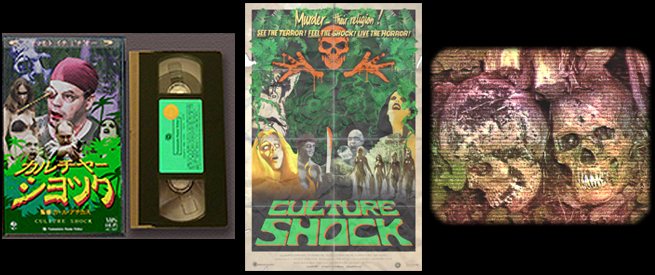
Culture Shock promotional materials

Culture Shock was Atticus's first known feature. Based upon Vernon Blake's 1923 novella "Jungle Drums," the film relates the gruesome tale of a band of smugglers who blunder into a tribal war between a group of savage pygmies and an even more bloodthirsty tribe of Amazonian women. The hapless gunrunners are picked off one by one; the final two men are forced to fight to the death by the Amazons.

According to contemporary reports, Atticus planned to film some or all of Culture Shock in a remote Louisiana parish adjacent to the location of Vernon Blake's upbringing. This plan was apparently scuttled for reasons which remain vague. Some sources claim that Atticus ran afoul of a local religious sect, while others maintain that the authorities caught wind of the unauthorized production and shut it down. The film was ultimately completed in Maryland.

Produced by "S/A Films," the project was financed by Margaret Atticus (Karl's mother) and T. K. Shelton, a partner of the advertising agency at which Atticus was employed by day. Upon completion the film was screened at Shelton's urging for New York-based promoter Damien Long, who took an interest and booked it as a midnight feature at his East Side theater, where it played for several months. Other East Coast screenings followed, and the film became something of a minor hit for a brief period.

Foreign press materials indicate that the film was definitely released in other countries, and it was actually released on VHS in Japan in the early 1980s, but it seems to have never again been screened theatrically in the United States.

Mortal Remains (1972 film)
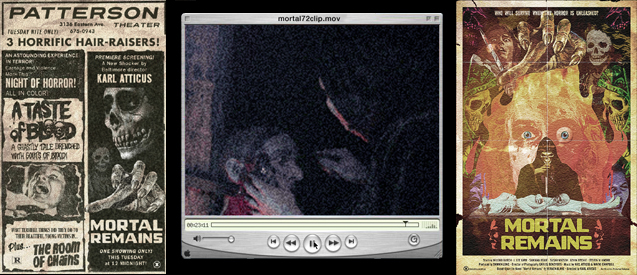
Mortal Remains promotional materials

Mortal Remains is Atticus's second and most notorious production. One of the most elusive lost films since the birth of the moving picture, it has never been screened in its entirety; a partial screening at a Baltimore theater in June 1972 marked its only exposure to a public audience.

The film was based upon a 1926 novel by Vernon Blake (itself entitled Mortal Remains). Probably the best-known of Blake's works - those published under his own name, at any rate - the novel details the gruesome fate of a group of wealthy young socialites who unwittingly defile the temple of an evil sect known as the Qa'Desh.

Atticus, enamored of Blake's writings and the 1920s aesthetic, convinced producer Damien Long to fund an ambitious adaptation of the novel, utilizing period costuming and a vintage automobile rented from a local collector. According to surviving crew members, much of the film was shot at Atticus's Maryland home, a large house replete with antique furnishings. Some cast members went missing both during and after the film's production, which caused other members of the cast and crew to become uneasy.

It was during this period that certain rumors began to surface, to the effect that Atticus was plundering local graveyards for "props," though he was never definitively linked with any such activities. One crew member related a more plausible source for this particular myth: While a sequence set in a morgue was being filmed at a Baltimore mortuary (one with suitably antiquated porcelain fixtures), Atticus played a gruesome prank on his crew by opening a body bag and tampering with the cadaver within. The crew member indicates that this was the origin of what would eventually evolve into the local legend of "the director who used dead bodies in his movies."

In spite of a turbulent shoot, production was wrapped and the film edited over the next several months in anticipation of a June 1972 release. Atticus and Long scheduled a midnight premiere at the Patterson Theater in Baltimore; a 1972 newspaper clipping indicates that the film's theatrical run was to commence in earnest the following week at the Omicron, Long's theater in Manhattan.

As the film screened in Baltimore, the audience grew increasingly vocal; some patrons walked out as the graphic murder sequences became too much to bear. Others who remained in their seats recall that the atmosphere in the theater became charged with tension as the scenes of ritual murder became more and more intense. A group of men (described variously as "bikers" or "religious nuts") began brawling; others actually stormed the booth and, overpowering the projectionist, succeeded in tearing the film reel from the platter and dragging it into the street, where it was set alight.

According to local news reports the altercation escalated into a near-riot, with dozens of men and women struggling to either leave the building or locate and persecute those responsible for the film's content. Atticus apparently fled the theater before anyone could identify him, and he was not seen again in public for nearly a year.

The answer print of Mortal Remains was almost completely destroyed during the incident, and it is generally believed that no other prints exist. The original Atticus residence in Loch Raven burned to the ground in 1976, so it must be assumed that the original negative and any remaining elements were also destroyed at that time.

Film clips purported to be fragments of the original Patterson print have surfaced from time to time (the best-known clip appears to depict the graphic mutilation of a bound victim by a masked figure), but it is not known if these snippets are authentic or where they originated.

Atticus subsequently went into seclusion and was officially pronounced dead in September 1973 following his apparent suicide. As no intact print of Mortal Remains has ever been located, the film was never screened again, nor has it ever been released in any other format. Thus it remains not only lost, but forgotten as well...though its shadow looms large, its legacy having undoubtedly influenced many of the horror films of the 1970s and '80s.

Other Works
Page Under Construction - Please check back shortly.
The Atticus Legacy
Page Under Construction - Please check back shortly.
About Us - Meet the Filmmakers
Page Under Construction - Please check back shortly.